Discover Balinese dance
Immerse yourself in a world where every movement has meaning and tradition blends with spirituality. Fancy immersing yourself in Balinese culture while perfecting your practice?
What is Balinese dance?
Balinese dance is far more than just an art of movement. It draws its roots from Bali's thousand-year history, where it embodies a symbolic language rich in cultural meaning. Every gesture, every posture tells a story, often inspired by Hindu legends or local myths.
Stemming from Balinese religious and spiritual traditions, the dance is deeply intertwined with sacred ceremonies. Dancers become intermediaries between the human world and the divine, conveying messages of peace, harmony, or protection. Each dance, whether joyful or solemn, plays a specific role in Bali's cultural life.
In Balinese society, dance occupies a central place. It is taught from a young age and represents a true family legacy. During religious ceremonies, village festivals, or temple celebrations, it becomes a way to bring communities together and strengthen social bonds. Dancers are often seen as the guardians of Balinese culture.
There are several styles of Balinese dance, each with its own rhythm and movements. The Legong, a graceful and codified dance, is often performed by young girls. The Barong, on the other hand, stages a mythical battle between good and evil, with imposing costumes and powerful movements. Kecak, with its enchanting singing, is a dramatic dance that transports spectators into a collective trance.
Preparation for Balinese dance practice
Traditional attire and accessories
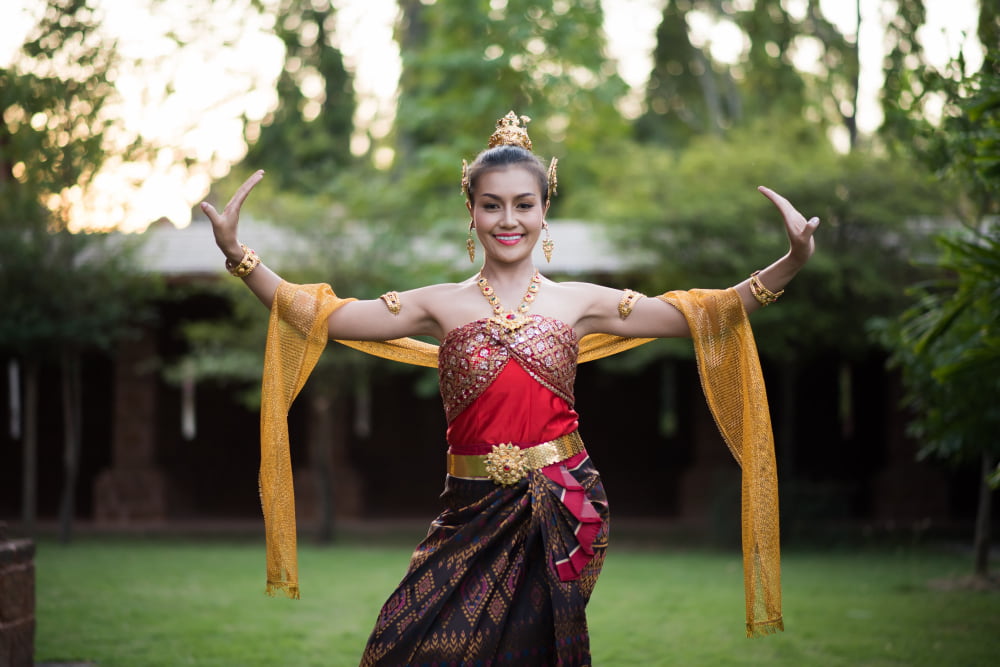
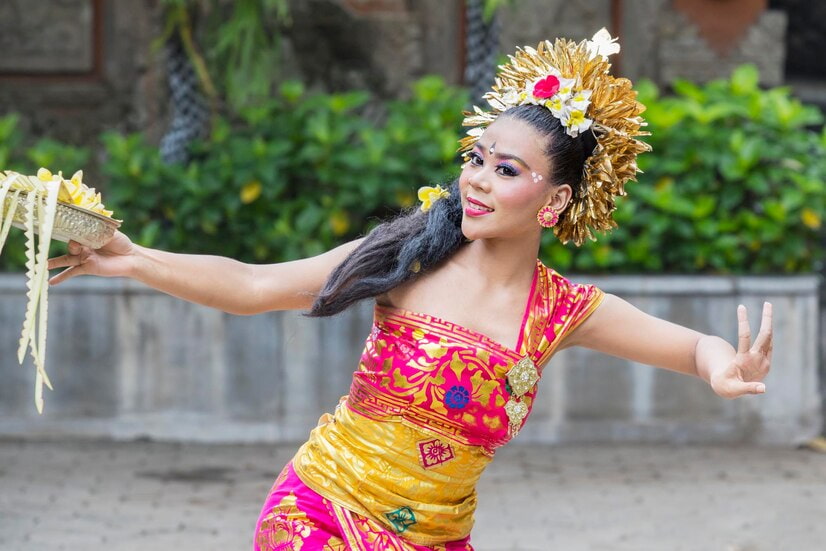
The traditional Balinese attire is essential for fully entering the world of this sacred dance. Each element of the costume has a symbolic meaning. The dancers generally wear a Cloth (sarong wrapped around the waist) and a fitted bodice called Belt, representing the balance between heaven and earth. Bright colours and elaborate patterns are often chosen according to the dance performed, whether it is joyful or spiritual.
Hairstyling plays a key role in Balinese dance. The hair is often pulled back and adorned with fresh flowers, like frangipani trees, symbols of purity and beauty. Golden crowns, sometimes encrusted with precious stones, complete the attire, adding a regal touch to the dance.
Makeup is designed to accentuate facial expressions, which are crucial in Balinese dance. Thick eyebrows, smoky eyes and well-defined lips amplify the emotions expressed through the face. Every brushstroke is intended to make the dancer more expressive and captivating.
Learning the basics of Balinese dance
Posture and body position
The «agem» basic position»
The Balinese dance begins with a specific posture called «age», which is the very essence of this discipline. This position implies a solid grounding, symbolising the connection between the body and the earth. The feet are apart, one knee is bent, while the other leg remains straight, giving the dancer a majestic and grounded appearance.
Correct spinal alignment
Good posture is fundamental for maintaining grace and fluidity in movement. The spine must remain straight and well-supported, which accentuates the elegance of gestures while ensuring stability.
Foot and leg placement
The feet and legs play a fundamental role in executing dance movements. Every step is measured, every position is controlled. The feet must be well-positioned on the floor, while the knees are slightly bent, allowing for a flexibility that facilitates transitions between movements.
Fundamental hand and finger movements
Essential mudras and their meaning
THE mudras, The positions of the hands are essential in Balinese dance. Each finger gesture has a symbolic meaning, telling stories, expressing emotions or representing mythical characters. These gestures are meticulously crafted to be both precise and graceful.
Exercises to improve finger flexibility
To master these mudras, it is important to practice finger flexibility exercises. These exercises help to develop the agility needed to perform complex and expressive movements, which are at the heart of Balinese dance.
Coordination of hand movements with the rest of the body
Balinese dance demands perfect coordination between hand movements and the rest of the body. The hands must be in harmony with the feet, legs, and facial expressions, in order to create a fluid and coherent whole.
Facial expressions (netra)
Eye movement control (seledet)
The eyes, or «netra», play a key role in Balinese dance. The celery, or rapid eye movement, is used to accentuate emotions or to follow the rhythm of body movements. This precise control of the eyes is essential for conveying the intensity of emotions.
Key emotional expressions
In Balinese dance, facial expressions are as important as the body movements. Each emotion – joy, sadness, anger, or love – is expressed through micro-facial expressions that captivate the viewer and bring the dance to life.
Exercises to develop facial expressiveness
To perfect these expressions, specific exercises are practised to strengthen the flexibility of the facial muscles. These exercises allow for the control of the eyebrows, lips, and eyes to be worked, amplifying the emotional impact of each performance.
Advanced techniques and interpretation
Narration through dance
Balinese dance is not merely a sequence of graceful movements. Above all, it is a powerful storytelling tool. Each dance tells a story, often inspired by mythological epics like the Ramayana where the Mahabharata, or local Balinese legends. The dancers become storytellers, expressing the highs and lows of these narratives through their gestures and expressions.
In advanced dance, emotions are no longer confined to simple gestures. Dancers must master a complex range of feelings, from radiant joy to profound sadness, or even intense anger. This expression is achieved through a subtle combination of body movements, of the facial expressions (eyes), and Eye movements Rigorous training allows dancers to refine their ability to convey these emotions with finesse.
Each dancer embodies a well-defined character: the noble prince, the graceful princess, the formidable demon, or even a god. These classic characters each have their own style of movement and expression. For example, a prince will be represented by broad, confident, and elegant movements, while a demon will adopt more abrupt and jerky gestures. The dancer's challenge is to fully enter into the role, to become this character, in order to offer a credible and captivating interpretation.
Mastery of Accessories
Dans certaines formes de danse balinaise comme le Legong, the fan is an indispensable accessory. It is not merely decorative, but becomes an extension of the dancer's movements. It is used to accentuate gestures, to highlight an emotion, or even to symbolise certain elements of nature. The manipulation of the fan requires great precision and must be done in perfect synchronisation with the rest of the body.
THE Offerings are often used in Balinese religious dances, symbolising the act of devotion to the gods. The handling of flowers, offering trays or candles must be done with respect and delicacy, as these sacred objects embody prayers in motion. Their use requires great concentration so as not to interrupt the spiritual flow of the dance.
Balinese costumes, often heavy and elaborate, pose a real challenge for dancers. Whether it's the imposing outfits of Barong or delicate dresses Legong, Costume management is a technique in itself. Dancers must learn to move with ease while wearing clothing that can restrict their movement. This requires physical strength, meticulous preparation, and careful attention to every detail of the costume to avoid any accidents during the performance.
Practice and refinement
Creating an effective workout routine
Balinese dance requires regular and rigorous practice in order to be mastered. Ideally, a dancer should train at least three to four times a week, with sessions lasting one to two hours. This frequency not only helps to improve technique but also to maintain the necessary flexibility and stamina. It is also recommended to alternate between sessions focused on technique and those on interpretation for balanced development.
To perfect Balinese dance, it is crucial to find a balance between the mastery of technical movements, the expression of emotions, and the development of physical endurance. Dancers must not only repeat postures and gestures, but also work on their ability to maintain them with elegance for the entire duration of the performance. Expression, on the other hand, must be constantly perfected to remain authentic and captivating, even in the most physically demanding passages.
Self-assessment is a key element in a dancer's progression. Using mirrors during practice, it allows for real-time posture correction. Furthermore, film your sessions is a valuable method for reviewing performances from a different perspective. It helps to spot imperfections that the dancer cannot always perceive live, and to observe important details such as the fluidity of movements or facial expressions.
Cultural and spiritual integration
Understanding the ritual context of Balinese dance
Balinese dance is deeply rooted in the island's spirituality. Every movement is an offering to the gods, and it is an integral part of religious ceremonies. Whether for temple celebrations or family rituals, dance is perceived as a way of communicating with the deities. Through their gestures and postures, the dancers become intermediaries between humans and the spiritual world, bringing prayers in the form of movement.
Dans la danse balinaise, chaque mouvement a une signification. Spiritual dimension. For example, hand gestures (mudras) symbolise prayers, while body postures evoke the balance between good and evil. Costumes, rich in symbolism, also represent this divine connection. Brightly coloured fabrics and golden ornaments are not chosen at random, but for their spiritual significance, attracting good energies and warding off evil spirits.
practising Balinese dance requires not only technique but also a Profound respect for traditions. It is essential to know the rites and etiquette surrounding the dance. This includes gestures of devotion before and after the performance, prayers, and sometimes even offerings. Dance is not simply an art, but a sacred practice that must be honoured by following the customs established over centuries.
Appreciation of Balinese dance art
To fully appreciate Balinese dance, nothing beats the experience of attending a Traditional performance. Whether in a temple or at a village ceremony, these performances offer a unique glimpse into dance within its original context. Observing the dancers in action, in their ritualistic setting, allows one to grasp the emotional and spiritual depth of each movement, beyond mere technique.
There is a great diversity of Balinese dance styles, each with its own specificities. The Legong, for example, is a graceful and codified dance, while the Barong is more theatrical and tells a battle between good and evil. Understanding the differences between these styles and their cultural significance allows for an appreciation of the richness of this art in all its complexity.
Practising Balinese dance isn't just about learning the techniques. For many dancers, it becomes a form of meditation in motion, allowing them to reconnect with themselves and the spiritual world. Dance offers a Inner reflection, a way to find harmony and balance in everyday life. Each repetition, each performance is an opportunity to improve oneself not only as a dancer but also as an individual.

Conclusion
Balinese dance is a unique traditional art, blending graceful movements with spiritual symbolism. Through specific postures, precise gestures, and rich facial expressions, it allows for the telling of captivating stories and a connection to the divine world.
By practising this dance, you will not only develop your technique, but also your understanding of Bali's cultural and spiritual traditions. It is a profound means of expression and moving meditation.
Dance with DECIBEL
If you're looking to combine dance and cardio, DECIBEL® is the perfect option! Join our 45-minute sessions where dance and fitness blend to boost your stamina and tone your body.
Immerse yourself in energetic choreography, in a friendly atmosphere. Our enthusiastic coaches will guide you to work your abs, thighs and glutes, all to uplifting music and under soothing lighting.
At DECIBEL®, pleasure and effort go hand in hand! Book your session now in our Beaubourg studio!