Summary
Heels Dance: Origins and practice of dancing in heels
Heels dance is dancing on heels that mixes posture, technique, and attitude. It originates from cabaret, jazz, and pop music videos. Today, it is practiced in studios, in an accessible setting.
This discipline is based on simple foundations such as walking, balance, and alignment. It develops confidence, presence, and coordination. No prior experience is required.
Wondering what heels dance really is and if it's for you? Want to understand where it comes from and how it's practised? This article is here for you.
Summary
What is heels dance
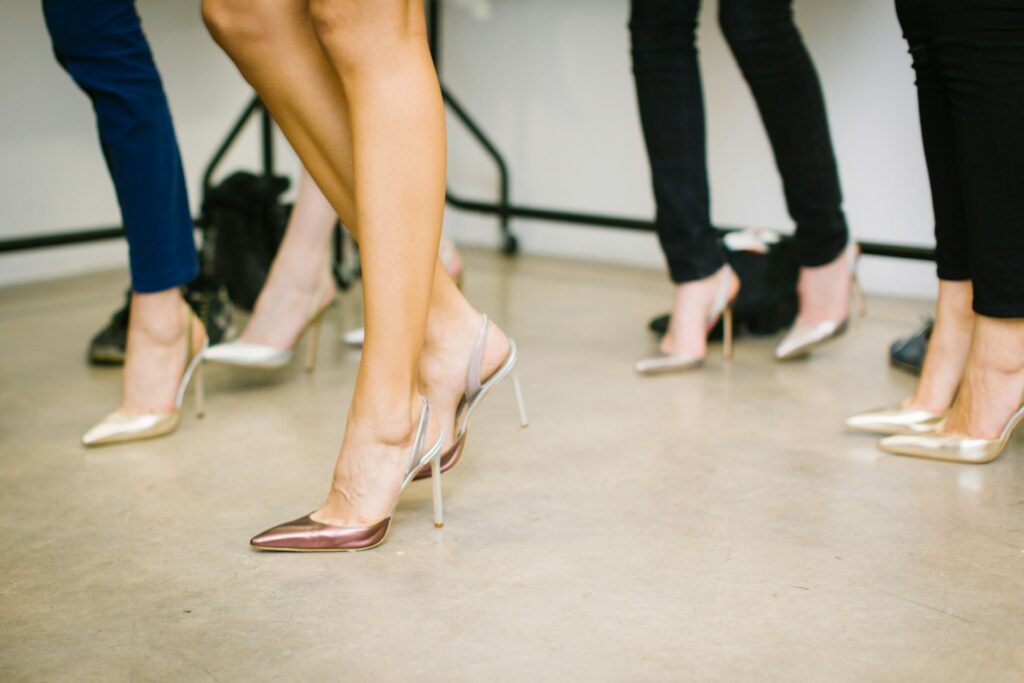
Heels dance is a style of dance that is performed wearing high-heeled shoes. It often incorporates elements of jazz, hip-hop, and contemporary dance, with a focus on femininity, sensuality, and power.
Heels dance is a dance that's practiced in heels. Yes, it's as simple as that.
But be careful, we're not just talking about walking in heels to music.
Heels dance blends technique, attitude, and interpretation.
You're learning to move, turn, pose, breathe, look... all in heels.
It's a solo dance, expressive, often inspired by music videos, cabaret, and jazz.
The goal isn't to be perfect. The goal is to feel strong, present, alive.
Heels dance vs. simple dancing in heels
Dancing in heels doesn't mean doing 'Heels' dance.
Wearing heels for a choreography isn't enough.
In heels dance, everything starts from the heel.
Posture, walking, weight shifts, balance, body alignment.
Each step is built to remain stable, fluid, and elegant despite the height.
We learn to use the heel as a tool, not as an obstacle.
In plain English:
Heels dance isn't “I dance and I have heels.”.
I dance because I have heels.
Why is it also called “heel dancing”?”
In French, heels dance is often translated as “danse sur talons”.
Because it says exactly what it is. And it speaks to everyone.
It's clearer for a beginner.
No need for jargon, no need for English.
When you see “cours de danse sur talons”, it almost always refers to heels dance.
Same content, same spirit, same vibe.
The name changes depending on the studios.
The sensation, however, remains the same:
You, music... and heels that tell a story.
Why is heels dance so popular today?
Self-confidence and posture
Heels dance is a dance class... and a little inner reset. You sometimes arrive shy, a bit stiff, “not sure of yourself”. And then, as the minutes go by, your posture changes. Not because you're playing a role. Because your body aligns and finds its place.
Heels make you engage your core, open your chest, and keep your neck long. As a result, you stand straighter, look further ahead, and breathe better. And that shows. You don't “pretend” to have confidence, you build it.
And the coolest thing? Nobody asks you to be “sexy”. You choose your energy. Gentle, powerful, funny, intense... anything goes. Confidence here isn't a front. It's a feeling.
The pleasure of performance and attitude
Why do we get hooked quickly? Because heels dance has a “stage” aspect to it. Even if you're dancing at the back of the room, you live the moment as if you were in a music video. There are sharp poses, looks, accents on the music. It feels good, full stop.
You play with attitude, without taking yourself too seriously. A simple step can become iconic with just timing, a pause, a look. That's where the magic happens: the dance becomes a story, not a sequence of movements.
And besides, let's be honest: it's fun. You sweat, you laugh, you fail, you try again. You leave the class with “main character” energy. Even if your day was rubbish, you leave with a little something extra.
The physical and mental benefits
Yes, heels dance uses muscles. But not in a “brutish” way. You are primarily strengthening what stabilises you: legs, glutes, ankles, and the famous core. You gain control, coordination, and balance. You will feel your body to be stronger, more awake.
Mentally, it's a real disconnection. You have to listen to the music, think about your footing, and memorise choreography. It's impossible to ruminate at the same time. Your brain lets go, and it feels amazing.
And there's a discreet bonus: you learn to be comfortable with the gaze of others. Not to please. To exist. You take your place in space. You give yourself permission. And frankly, that's powerful.
The origins of heels dance
Roots in cabaret and revues
Long before heels dance was a thing, people were already dancing on stage in heels.
In cabarets, Parisian revues, and burlesque, heels were part of the costume. They lengthened the silhouette. They added stature. They imposed a gait.
The dancers were learning to walk, pose, and turn in heels. Not for style. To survive on stage without falling.
Little by little, a real way of moving was born around that. A specific way of moving in heels.
We weren’t yet talking about “heels dance”.
But the DNA was already there: posture, elegance, presence, gaze.
The influence of jazz and live performance
Jazz did the rest.
In musicals and Broadway shows, female dancers began to dance in high heels in a choreographed manner.
It features long lines, sharp poses, and precise movements.
The body tells a story. The gaze does too.
Heels are no longer just for looking pretty.
They are becoming a stage tool in their own right.
That's where the technique comes in.
Alignment, balance, timing, musicality.
The foundation of modern heels dance is built here.
The impact of music videos and pop culture
Then come the clips.
90s, 00s. Beyoncé, Janet Jackson, Madonna, Britney Spears.
Dancers in heels, ultra powerful, ultra present.
The choreographies are becoming iconic.
Slow marches. Strong poses. Looks to camera.
Everyone wants to do the same in their living room.
Heels are leaving the stage to enter the dance studios.
Teachers are starting to create “heel” classes, inspired by music videos.
And then, the style explodes.
The birth of modern heels dance
It is in the studios, especially in Los Angeles, that heels dance takes its current form.
Choreographers like Yanis Marshall, JoJo Gomez and Brian Friedman set the standards. Technically, we structure it, create foundations, and blend jazz, commercial, attitude, and storytelling. Heels dance is becoming a discipline in its own right, with dedicated classes, specialist teachers, and distinct styles.
Today, she travels everywhere: Paris, London, Tokyo, Berlin… And in each studio, she keeps the same spirit: heels, music… and a crazy energy!
Essential technical foundations in heels dance
Posture and body alignment
It all starts here: without good posture, heel dancing quickly becomes wobbly and tiring.
You're looking for a simple sensation: to grow through the crown of your head, engage your core, relax your shoulders. Your pelvis stays neutral. Your chest is open, but not arched.
The heels pull you forward. Your job is to bring your weight back to the centre.
When the alignment is good, everything becomes more fluid: steps land better, turns are less daunting, and your silhouette changes, without effort.
Walking in heels, dance version
Walking in heels for dancing isn't the same as walking down the street. It's a stylish, controlled, almost choreographed walk.
You first place the ball of your foot, then your heel. You transfer your weight without “falling” into it.
The hips accompany the movement. The torso remains stable. The gaze guides the direction.
This is the number one foundation; without a good walk, everything else becomes complicated. Don't worry: it's quick to work on, and it changes everything!
Balance and axis
In heels, your balance becomes precious. Every micro-shift is felt immediately. You learn to maintain a straight line, from the crown of your head to your toes. The core supports every movement.
For turns, your gaze becomes your best ally: you fix a point, you turn, and you find that point again.
At first, it wobbles a bit, nothing unusual. Then, one day, it holds steady. And then, you smile to yourself!
Musicality and intention
With heels dance, it's not just about the steps, it's a way of playing with the music.
You learn to hit the accents, to slow down when the music breathes, to strike a precise stop on a beat, and above all: you put in intention, a look, a pause, an attitude.
The same movement can tell a thousand things: power. gentleness. provocation. fragility. This is where dance becomes alive.
The isolations and floorwork
Isolations are focused movements: torso, shoulders, hips, head. They give movement style, groove, and texture.
Floorwork, on the other hand, is done close to the ground. Descending, hand supports, low poses.
It remains optional for beginners, but when you get there, you definitely feel badass!
Frequently asked questions about heels dance
Do you need to know how to dance already to start?
You don't need to have had ten years of dance experience to start heels dance.
Many people start without any experience, and it goes very well.
Beginner courses are designed for that.
The teachers explain posture, walking, stances, and rhythm.
Your only real condition is desire.
The desire to try, to fail, to start again, to progress.
And honestly?
Everyone looks awkward in the first lesson.
Even those who dance very well today.
What heel height for a first class
A first date isn't for wearing 10-centimetre heels.
The body needs time to understand balance.
A height of between 5 and 7 centimetres works very well for beginners.
A stable heel, not too thin, with good ankle support makes all the difference.
Your goal isn't to look stylish from day one.
Your goal is to feel safe and in control.
The height will come later.
Confidence, too.
Can we come without heels
Yes, and yes a thousand times.
Coming in trainers or socks for the first lesson is still a very good idea.
The body is already learning posture, gait, axis, and musicality.
The heels can wait a bit.
Many studios even encourage this approach.
You integrate the technique first.
You add the heels afterwards.
And when do you put them on for the first time?
Guaranteed thrill.
Does heel dancing hurt your feet?
Heels dancing should never hurt.
Slight discomfort may occur at first, especially around the ankles and under the arch of the foot.
Sharp pains are not normal.
They often indicate ill-fitting heels or a wobbly posture.
Good support, a reasonable height and clean technique make all the difference.
The body adapts quickly when respected.
And no, you're not supposed to suffer to be stylish.
How long to feel comfortable
The first few weeks often feel like happy chaos.
The brain overthinks.
The body hesitates.
Then one day, without warning, the walk becomes natural.
The towers are less scary.
The poses fall just right.
Generally, three to five lessons are enough to feel a real breakthrough.
Consistency does the rest.
And spoiler:
Even advanced dancers continue to learn.
Heels dance is a very broad term for any style of dance performed in high heels, encompassing a wide range of techniques, genres, and aesthetics. It can include elements from hip-hop, jazz, contemporary, ballroom, and more, often focusing on sensuality, power, and technical execution while navigating the challenges of dancing in heels. Heels cabaret, on the other hand, is a more specific genre that typically draws inspiration from classic cabaret and burlesque performances. While it also involves dancing in heels, the emphasis is often on theatricality, storytelling, characterisation, and a more playful or seductive performance style. It might incorporate elements of showgirl aesthetics, flirtatiousness, and a narrative that unfolds through the dance.
Heels dancing encompasses several styles.
The cabaret heels are part of it.
Cabaret places more emphasis on theatre, elegance, and stagecraft.
The movements are often slower, more deliberate, more narrative.
Heels dance “classique” can be closer to music videos, jazz, or commercial styles.
The rhythm is changing.
Energy too.
In fact, many studios mix the two.
And frankly?
As long as you feel powerful in heels, you're in the right place.
Conclusion
Heels dance is a dance on high heels that blends technique, posture, and attitude. It originates from cabaret, jazz, and music videos, and is now practised in studios in an accessible setting. It's for anyone who wants to move, feel strong, and gain confidence.
This discipline is built on simple foundations such as posture, walking, and balance. It strengthens the body, frees the mind, and develops presence. It requires no prior experience, only the desire to try.
If the subject intrigues you, other articles can guide you. You can discover how to choose your heels or find a beginner's class. Heels dance might just be the start of your dance adventure.
Read also
follow us
on instagram
Follow our news,
take advantage of our tutorials and participate to our
contests!
BREAKING NEWS!
Receive our newsletter.