Step dance: definition and origins
A dance of the feet, above all
Tap dance is a generic term that refers to dance forms in which the footwork is the main element. The arms? They are secondary, or even still depending on the style. Everything happens below: striking the floor, rhythms produced by the feet, precision of the steps.
Its history is long and multicultural. The origins go back to Irish, Scottish and English folk dances, where feet would tap out rhythms on wooden tables or boards. But step dance also has African, Latin American (Mexican zapateado, Argentinian malambo) and American roots. Each culture developed its own version.
Today, step dance is practised all over the world, both competitively and for pleasure, in dance studios and associations.
Step dance, tap dance, step fitness: the three not to be confused
It's often seen: the term «step dance» creates confusion with two other disciplines that have similar names. Here's a table to help you find your way:
Discipline | Definition | Accessories |
Step dance | Footwork: taps, rhythms, footplay | Soft-soled shoes or flip-flops |
Tap dancing | American tap dance (jazz, Broadway) | Studded shoes |
Step fitness | Cardio workout with a raised platform | Platform (plastic step) |
Step dancing is a dance. Step fitness is a cardio sport. That is the fundamental difference.
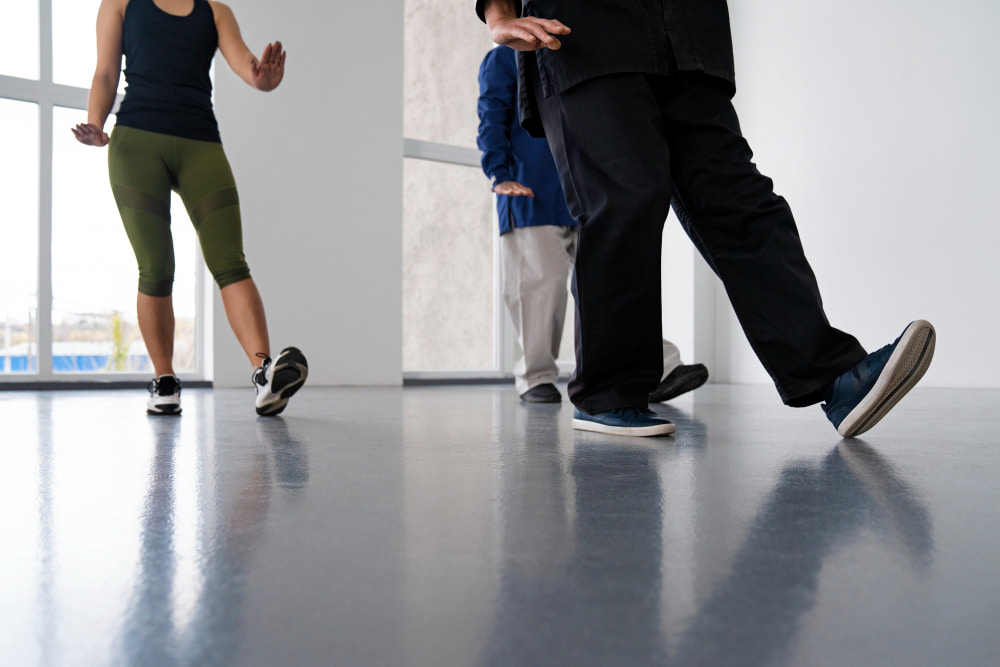
Styles of step dance in the world
Irish step
It's the best known to the general public, particularly thanks to the shows Riverdance and Lord of the Dance, which have toured the world since the 1990s. Irish step dance is characterised by very fast and precise footwork, while the arms remain strictly by the sides.
It's an old tradition: the first official Irish step dance competition dates back to 1897. Today, it's practiced both competitively (with elaborate costumes and strict rules) and in workshops for enjoyment.
American «stepping»: a fraternity tradition
In the United States, another form of step dance developed in African-American university fraternities and sororities. «Stepping» is a collective and theatrical practice: synchronised groups perform combined routines of stomping, clapping, and chanting.
It's a strong cultural expression, linked to the history of Black Americans. «Step shows» are true competitions between organisations, a mix of choral performance, humour, collective energy and technique.
Contemporary fusions: hip-hop, urban, and beyond
Contemporary step dance is constantly evolving. It has merged with hip-hop, urban dance, jazz, and even percussive dance. Companies from all over the world are mixing codes to create hybrid performances.
It is in this spirit, moreover, that DECIBEL integrates rhythmic and step elements into its fitness dance classes. The aim: to retain the fun and energy of step dance, within a framework accessible to all.
The benefits of step aerobics
Cardio and calories burned
Step dance is an excellent cardio workout. An active session can burn between 300 and 500 kcal per hour depending on the intensity and level of practice. Repeated strikes continuously engage the legs, the pace quickly increases, and your heart works without you feeling like you're doing «classic» sport.
Compared to a brisk walk (around 250 kcal/h) or a gentle yoga class (150 kcal/h), step dance is more akin to a fitness dance class or a cardio rhythm-raising session.
Coordination, rhythm and memory
Learning step sequences, synchronising your feet with the music, memorising combinations: step dance is a real cognitive exercise. It engages rhythmic memory, kinaesthetic memory and arm-leg coordination.
Research shows that the regular practice of dance, including step dance, can improve neural plasticity and even slow down age-related cognitive decline. A significant advantage, at any age.
Self-confidence and creative expression
There is something very liberating about making noise with your feet, keeping time, expressing yourself through movement. Step dance values a form of physical expression that doesn't rely on flexibility or grace, but on precision and rhythm.
For beginners who have never danced before, it's often a revelation. Making quick progress with simple steps, feeling the rhythm in your body, gaining confidence: step dance offers all of that, in a non-judgmental environment.
How to start step dancing?
The necessary equipment
Good news: tap dancing doesn't require a lot of equipment. The essential items are the shoes.
- Soft and light shoes Thin sole, good ankle support, breathable materials (leather or suede often preferred)
- Tap shoes (optional): For Irish step dancing or tap dancing, metal taps are attached under the heel and the toe.
- Comfortable attire Leggings or soft trousers, fitted top, nothing constricting
- Suitable surface: Parquet or wooden flooring ideal for feeling vibrations and producing a clean sound
In a group class, the studio generally provides information on suitable footwear according to the style being taught.
The fundamental steps to get started
Everything begins with simple steps. There's no need to rush into complex sequences: consistency and precision take precedence over speed.
- The basic step Alternating step, right foot / left foot in rhythm, the basis of all learning
- Le shuffle. quick footwork, light and fluid, close to the ground
- Le stomp Powerful and unique surprise, to mark a highlight or conclude a sequence
- The tap Light strike on the point or heel, without weight transfer
These four elements allow for dozens of combinations to be built. The first lessons are often dedicated to mastering them one by one, before stringing them together.
Tips for rapid progress
- Practice regularly Even 15 minutes a day is better than one long session per week
- Work slowly at first: Accuracy before speed, always
- Count aloud It helps enormously for internalising the rhythm and anticipating the beats.
- Watch performances YouTube is brimming with American step shows and Irish step dancing, very inspiring.
- Join a group class A coach's feedback and group dynamics considerably accelerate progress
FAQ : Your questions about step dance
La principale différence entre la danse à claquettes et la danse step réside dans le son et la façon dont il est produit. La danse à claquettes utilise des claquettes métalliques fixées aux chaussures pour produire des sons percussifs rythmiques. La danse step, quant à elle, est réalisée avec des chaussures sans claquettes métalliques, en utilisant la vibration des pieds et la frappe du sol pour créer des rythmes.
The two have in common footwork and the production of rhythmic sounds. The big difference: tap dance uses special shoes with metal taps attached under the heel and toe, which produces a very specific sound. Step dance, on the other hand, can be practised with ordinary shoes and doesn't necessarily require making noise.
Tap dance is also more strongly associated with jazz and Broadway, while step dance covers a more varied range of styles, from Irish to American stepping.
Is step dance difficult for beginners?
No, and that's one of its great qualities. The basic steps are accessible from the very first sessions. What takes time is the precision and fluidity of the combinations. But unlike other disciplines (classical, acrobatic), step dance does not require particular flexibility or specific physical predispositions. Rhythm can be learned.
Most beginners leave their first session with a smile and the basics under their belt.
How many calories does one burn doing step dance?
Between 300 and 500 kcal per hour, depending on the intensity and your build. An intensive American stepping session (with lots of hand claps and strikes) will burn more calories than a moderate Irish step dance class.
What is certain: step dance works the heart. It is a full-fledged cardio activity, far from the purely artistic image some associate with it.
Fancy a dance? DECIBEL awaits
Tap dancing is a brilliant gateway into the world of dance. It's accessible, rhythmic, musical and, above all, fun. You don't need any particular level to get started.
At DECIBEL, Our classes mix dance, energy, and good humour. In a Parisian studio that prioritises accessibility. Caring coaches, a non-judgemental atmosphere, and 45-minute sessions that make you want to return.