Summary
Flamenco: origins, styles and techniques of the dance
THE flamenco It is an art born in Andalusia that brings together three disciplines: singing (cante), guitar (toque) and dance (baile). Heels clicking, arms entwined, intense gaze: you have probably already seen it on stage or in video, and it is difficult to remain indifferent to it.
Registered as intangible cultural heritage of humanity by UNESCO since 2010, flamenco is part of the dances from around the world the most recognizable ones. But where does it come from? What is a palo? How does the zapateado work?
In this guide, we explain everything: the origins of flamenco, its major styles, basic techniques, the dress code for the dancer and the dancer, and how to get started when you first start. ¡Olé!
Summary
What is flamenco?
Flamenco is not just a dance. It is a complete language, where the voice, the guitar and the body dialogue in real time. On stage, one usually finds a flamenco painting : one or more singers, a guitarist, dancers and palmeros who mark the rhythm with their hands.
- The song The singing, considered the heart of flamenco. The singer is called the cantaor (or the cantaora).
- The toque The flamenco guitar, played by the tocaor, which provides harmony and supports the rhythm.
- The baile : the dance, performed by the bailaor or the bailaora.
- The palm trees and the jaleo the hand claps and the encouragement («¡Olé!», «¡Eso es!») that carry the artists.
All this little world is looking for duende : This moment of grace where the emotion becomes almost palpable, for both artists and the audience. The word is difficult to translate, but you will recognize it when you feel it, I promise.
On November 16, 2010, UNESCO inscribed flamenco on the Representative List of the Intangible Cultural Heritage of Humanity, at the initiative of Andalusia, Extremadura and the Murcia region. Since then, November 16 is celebrated every year as World Flamenco Day.
The origin of flamenco: where does this dance come from?
Among the traditional Spanish dances, Flamenco occupies a special place. Its origin remains debated by historians, but one point is agreed upon: it originated in the lowlands of Andalusia, in the south of Spain.
A mix of cultures
Flamenco is the fruit of several centuries of coexistence. The Gypsy communities, who arrived on the peninsula in the 15th century, brought their songs, their sense of rhythm, and their way of dancing with them. They crossed the Arab-Andalusian and Jewish heritage, as well as the Andalusian folk music.
These influences were intertwined in family celebrations, blacksmiths, and working-class neighborhoods. Flamenco first passed down orally from generation to generation long before it was written or recorded.
Where does the word «flamenco» come from?
No one knows for sure, and several hypotheses are circulating:
- Flamenco = Flemish In the 19th century, the word also served to designate the Gypsies in Andalusia, perhaps ironically or in connection with the Flemish present at the Spanish court.
- An Arab origin Some associate «flamenco» with the expression «felah mengu», which would mean a peasant without land or a fugitive.
- The flaming rose In Spanish, «flamenco» also refers to this bird. Some see it as a nod to the proud and upright posture of the dancers.
Singing cafés and the new flamenco
In the mid-19th century, flamenco moved out of family circles to take to the stage. singing cafes They are multiplying: people have a drink there while listening to artists paid to perform. Singer Silverio Franconetti opens his own in Seville and helps establish the great styles. This is the golden age of flamenco, and it is here that dance takes on a whole new dimension.
In the 20th century, flamenco moved from theaters to tablaos, These rooms feature a small wooden stage. In the 1970s and 1980s, guitarist Paco de Lucía and singer Camarón de la Isla paved the way for the New Flamenco, who allows himself to play jazz, pop or percussion. It is indeed Paco de Lucía who introduced the cajón, a percussive instrument from Peru, into flamenco. Today, this art is danced and taught all over the world.
Spanish flamenco and its palos: the great styles
When we talk about Spanish flamenco, we are actually talking about a family of styles called palos. Each palo has its own rhythm, its accents, its atmosphere, and often its region of origin. There are more than fifty of them, from the most festive to the most serious.
The compás, the backbone of flamenco
The compass is the time cycle on which everyone aligns themselves. Many people use a compass to orient themselves. 12th place, With accents on the 3, 6, 8, 10 and 12 beats: this is the case of the soleá and alegrías. Others, such as the tangos, are based on a binary rhythm of 4 beats, easier to follow for a beginner ear.
Don’t panic if it seems abstract to you: the compás is mainly learned by tapping on your hands, counting out loud and by listening to a lot of music.
The festive sticks
- The alegrías Originaries of Cádiz, cheerful and bright, they often dance to the rhythm of the bata de cola and the mantón.
- The bulerías Quick, humorous and improvisational, they come from Jerez and often close the celebrations, with everyone walking to the center for a few steps.
- The tangos Binary and exciting, they are often the first scales taught to beginners.
The deep sticks: the cante jondo
THE cante jondo (« deep song ») brings together the most serious styles, those that speak of pain, lost love or injustice.
- The soleá She is nicknamed the «mother of flamenco», solemn and majestic. Her name comes from «soledad», loneliness.
- La seguiriya : undoubtedly the most dramatic palo, with an irregular rhythm that creates a constant tension.
The main features at a glance
| Palo | Atmosphere | Compás | For whom? |
|---|---|---|---|
| Tangos | Festive, engaging | 4-time (binary) | Ideal for beginners |
| Alegrías | Cheerful, bright | 12th place | Intermediate level |
| Soleá | Serious, majestic | 12 tempo, slow tempo | Intermediate level |
| Bulerías | Festive, improvised | 12 tempo, fast tempo | Brave dancers |
| Seguiriya | Dramatic, intense | 12 irregular times (2+2+3+3+2) | Confirmed dancers |
| Farruca | Simple, elegant | 4-time (binary) | Longtime danced by men |
The Flamenco dance: the basic techniques
Flamenco dance relies on a dialogue between the lower and upper body. The feet provide the power and rhythm, the arms and hands bring the poetry. In English, it is called flamenco dance, but the vocabulary remains Spanish worldwide. Here are the four pillars to know before your first class.
The zapateado: when the feet become percussion
THE clumsy (from «zapato», the shoe) refers to the work of the feet. The dancer becomes a fully-fledged instrument: his strikes correspond to the guitar and the palms. He combines several basic strikes:
- Strike : the entire foot strikes the ground, for a full and powerful sound.
- Planta The front of the foot strikes the ground, for a lighter sound.
- Tacón The heel strikes the ground, the front of the foot remaining in place.
- Punta The tip of the shoe hits the ground, usually behind you.
Connected at full speed, these strikes form a escobillas, These are the passages where the dancer shows off his virtuosity. At first, we work at a slow tempo, on a metronome, looking for a clear sound rather than speed.
The braceo and the floreo: the poetry of the upper body
THE braceo refers to the movement of the arms. They start from the back and shoulders, remain rounded and draw slow curves around the body. The floreo, This one, however, concerns the hands: the wrists turn and the fingers open one after another, like a flower that blooms.
This is often the part that beginners underestimate the most. Yet, a beautiful braceo requires relaxed shoulders, a toned back, and a lot of control.
The palms: the rhythm at the tip of the fingers
The palm strikes are hand claps that accompany flamenco. There are two main types:
- The sordas palms (mute): hollowed out hands, his voice muffled, to accompany the singing without covering it up.
- The clear palms (or breaks): the fingers of one hand strike the palm of the other, for a dry and brilliant sound in the energetic passages.
Palm strikes are the best way to learn the compás. Even before you start dancing, practice marking them on your favorite songs.
The posture: pride and anchoring
In flamenco, the posture says a lot already. The bust is straight and proud, the shoulders are low, the pelvis is placed, and the knees are supple to absorb the blows. The gaze accompanies the movement and gives intensity to every gesture.
This verticality is demanding: it requires the deep abdominal muscles, the back and the legs to work throughout the entire dance.
Flamenco dancer: the bailaora and her outfit
The flamenco dancer, or bailaora, For a long time, flamenco has been associated with a style focused on the upper body: ample bracero, refined floral patterns, and undulating bustlines. Today, flamenco dancers hit the floor with just as much energy as men, like Sara Baras and Rocío Molina.
In flamenco dance, the woman also plays with her outfit and accessories, which are an integral part of the choreography.
The performance of the flamenco dancer
- The dress or skirt with ruffles Adjusted to the hips and then tapered, it accompanies every step. It is called a traje de flamenca or faralaes.
- The cola battle : a long, heavy and spectacular gown. To make it fly at the right moment requires solid technique; it’s an art in itself.
- The mantón : a large shawl embroidered with fringes, which the dancer twirls around herself, especially in the alegrías.
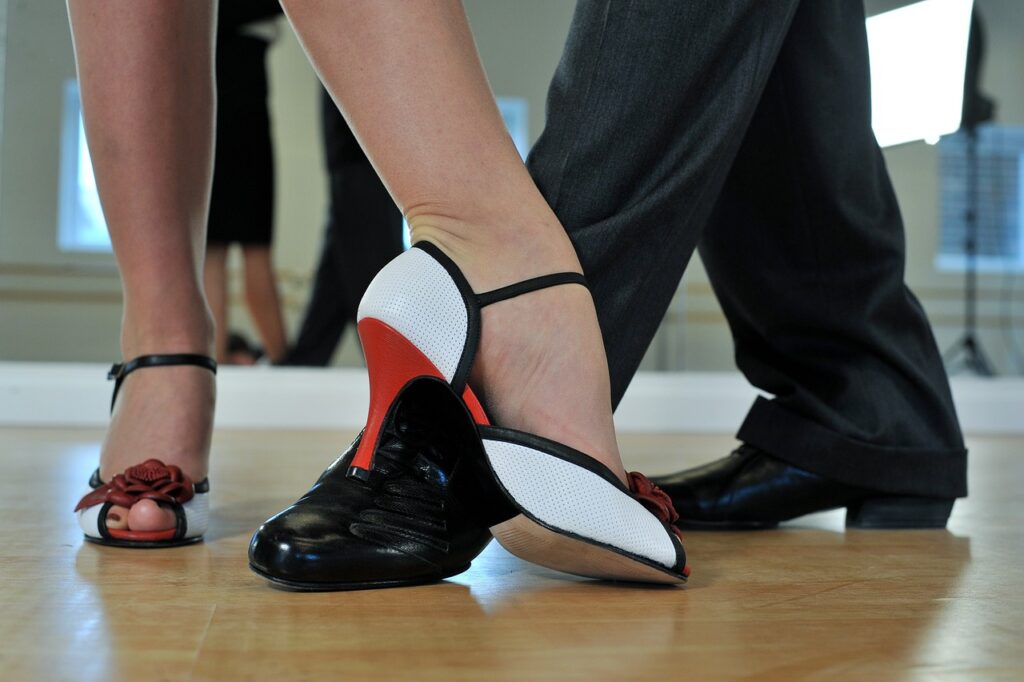
- The shoes : a heel of a few centimeters and small nails planted at the front and heel to make the zapateado sound.
- The hairstyle : a tight bun, sometimes adorned with a flower or a comb (the peineta).
The accessories: fan and flutes
L'fan (fan) opens, closes and swirls to the rhythm of the music. It is found in many cultures: if the subject intrigues you, discover it Dance of the fan, where he becomes the star of the show. The Castanuelas (castagnettes), however, are rarer in pure flamenco: they are mostly associated with Spanish folk and classical dances, although some palos use them.
Good news for beginners: for a first class, a wide skirt and shoes with a low heel are enough.
Flamenco dancer: the masculine style
The flamenco dancer, or bailor, Traditionally, the emphasis is on a more percussive style. Zapateado is king: quick strikes, quick turns, jumps and clean stops. The silhouette remains understated, almost austere, to emphasize the rhythm and tension.
The performance of flamenco by men
- The high-waist trousers, Black or dark, which elongates the silhouette.
- The shirt, Often white or black, sometimes worn with a vest (chaleco) or a short jacket.
- Boots or shoes with heels, They were also handcuffed.
- The Cordoba sombrero, This black hat with a flat brim is suitable for some parades or shows.
Figures who broke the codes
Antonio Gades made history with ballets such as «Carmen» and «Noces de Sang», while Joaquín Cortés took flamenco to the pop scene. Closer to home, Israel Galván broke through traditional codes, and Manuel Liñán dances with bata de cola and mantón, elements long reserved for women.
In contrast, Carmen Amaya remained famous for dancing in trousers, with a zapateado of power that had previously been attributed to men. Today, these boundaries are fading: everyone dances with their own energy.
Can you learn flamenco when you are just starting out?
Yes, and you don’t need to have grown up in Andalusia! Flamenco can be learned at any age. Like any codified dance, it takes patience, but progress is quick, especially with rhythm and posture.
What flamenco brings you
- Cardio exercise A well-executed zapateado quickly increases the heart rate.
- Reinforced legs and padding The buttocks, thighs, buttocks and abdominal muscles work continuously.
- A better posture The back straightens, the shoulders open.
- Coordination and memory The feet, arms, hands and compasses must work together.
- Self-confidence It’s hard not to feel powerful when you hit the ground with confidence!
Our tips for getting started well
- Start with the palms and the compás, even before the steps.
- Choose an accessible palo, like the tango.
- Work on the zapateado without seeking speed, by aiming at a sound of his own.
- Listen to a lot of flamenco to get a feel for the different atmospheres.
- Protect your joints: warm up your ankles and knees, and dance on a floor rather than on tiles.
FAQ about flamenco
Flamenco originated in Andalusia, in southern Spain, from the meeting between the Gypsy, Arabo-Andalusian, Jewish and popular Andalusian cultures. It took on its artistic form in the 19th century, particularly in singing cafés, and has been included in the UNESCO Intangible Cultural Heritage since 2010.
The sevillana is an Andalusian folk dance that is danced in pairs or in groups, on a fixed structure in four parts. Flamenco is a broader art, which combines singing, guitar, and dance around more than 50 palos, with a large part of improvisation. The sevillanas are often taught in flamenco schools, hence the confusion.
No. The paso doble is a couple dance inspired by the corrida, codified as a ballroom dance. It borrows some of the attitudes (proud bust, footwork, cape plays) from flamenco, but its structure and music are different. To learn more, read our article on the paso doble.
There are more than fifty different types of palos. They are classified according to their compás (12 time signatures, 4 time signatures or free rhythm), their atmosphere (festive or serious) and their geographical origin. The most well-known are the soleá, alegrías, bulerías, tangos and seguiriya.
On stage, the flamenco dancer wears a dress or a skirt with ruffles, sometimes a bata de cola (long, flowing dress), a mantón (embroidery shawl) and pointed-toe shoes. For a class, a wide skirt, a top close to the body and small-heeled shoes are sufficient.
Yes. Flamenco exercises the heart, legs, buttocks, and abdominal muscles, while also working on posture, coordination, and a sense of rhythm. It’s a complete activity that both energizes and improves mood.
Dance at DECIBEL®
Flamenco is a rhythm, a posture and an energy that leaves no one indifferent. From Andalusian singing cafés to stages around the world, it has managed to keep its soul while constantly reinventing itself.
Want to move, let off steam and feel the music in your entire body? At DECIBEL®, our 45-minute workout dance classes combine choreography, cardio and strength training, in an atmosphere that makes you want to come back. You don’t need to be a pro to try our dance classes!
Read also

follow us
on instagram
Follow our news,
take advantage of our tutorials and participate to our
contests!
BREAKING NEWS!
Receive our newsletter.